

 Last updated: February 11, 2026
 12 min read
If you’ve ever watched a new server struggle through their third day because nobody trained them the same way twice, you already know why restaurants are turning to learning management systems.
Training in restaurants has traditionally been… chaotic. One manager shows you how to use the POS system. Another teaches you a completely different way. The printed manual? It’s from 2019 and buried under expired invoices in the back office.
An LMS for restaurants fixes this. It gives you one system where everyone learns the same standards, managers can actually see who’s trained on what, and new hires can get up to speed without monopolizing your best server’s Friday night.
What Is an LMS for Restaurants?
A restaurant LMS is a digital training platform designed specifically for the realities of food service work. Unlike generic corporate training software, these systems understand that your team works in shifts, learns on phones, and doesn’t have time for hour-long training sessions.
Think of it as a central hub where servers, cooks, bartenders, and managers can access training whenever they need it—before their shift, during a slow Tuesday afternoon, or even at home on their phone.
What makes restaurant LMS platforms different?
They’re built for high turnover. In an industry where 75% annual turnover is normal, you need on boarding that works fast and scales easily.
They’re mobile-first. Your dishwasher doesn’t have a laptop. Your server is checking their phone between tables. The training needs to work on whatever device they actually use.
They’re designed for short attention spans. Instead of 45-minute videos, you get bite-sized lessons that fit into a 10-minute break.
Why Restaurants Are Using an LMS in 2026
Let’s be honest—most restaurants don’t wake up thinking “we need to modernize our training infrastructure.” They adopt an LMS because they’re tired of dealing with the same problems every week:
Inconsistent service: When every manager trains people differently, guests notice. One server says, “I’ll get that right out,” while another promises “2-3 minutes” for the same dish. Your brand suffers when training is a game of telephone.
Compliance nightmares: That food safety certification you thought everyone had? Turns out three people expired last month, and nobody noticed until the health inspector showed up. An LMS tracks this automatically.
Manager burnout: Your best shift manager shouldn’t spend four hours walking a new hire through basics that could be standardized. They should be coaching, not constantly reteaching “How to greet a table.”
Updates that never reach the floor: You changed the happy hour menu three weeks ago. Somehow, half your servers are still reciting the old one. With an LMS, you update once and push it to everyone instantly.
What Are The Key Benefits of LMS for your restaurant?
- Faster, consistent onboarding: New hires start immediately, often before or between shifts,s learning the same standards every time.
- Less pressure on managers: Core knowledge lives in the LMS, freeing managers to coach performance instead of repeating instructions.
- Built-in compliance tracking: Food safety, alcohol service, harassment prevention, and safety training can be assigned, tracked, and reported automatically.
- Training that fits restaurant life
Mobile-first, short lessons designed for downtime, not long classroom sessions. - Visibility into gaps
Operators can see who’s behind, where scores drop, and when retraining is needed. - Easy updates at scale
Update a recipe or SOP once and push it to every location, no reprinting or retraining chaos
Quick Comparison (2026 Picks)
| LMS | Best For | Mobile | Compliance | Multi-location |
| Manager Maven AI | Manager development + operations consistency | ✓ | ✓ | ✓ |
| Docebo | Enterprise scale + advanced analytics | ✓ | ✓ | ✓ |
| TalentLMS | Quick setup + simplicity | ✓ | Basic | ✓ |
| Absorb LMS | User experience + reporting | ✓ | ✓ | ✓ |
| SAP Litmos | Compliance-heavy programs | ✓ | ✓ | ✓ |
| LearnUpon | Structured programs + portals | ✓ | ✓ | ✓ |
| iSpring Learn | Turn existing docs into training | ✓ | Basic | ✓ |
1) Manager Maven AI

Best for
- Restaurant operators who want to develop leadership skills in managers
- Teams that need standardised training for managerial decision-making
- Brands focused on reducing variability in performance across locations
Manager Maven AI is an AI-powered restaurant LMS built specifically for hospitality teams, with a focus on management development, real-world scenarios, and leadership capability. Instead of only offering generic courses, it combines restaurant-specific learning modules, operational playbooks, and AI-assisted guidance to help managers improve performance and consistency across shifts and locations.
This platform is designed to address the challenges restaurant managers face, including fast-paced service, unpredictable issues, and the need to lead teams under pressure by delivering task-oriented learning, personalised learning paths, and progress tracking that aligns with real managerial responsibilities.
Key features
- AI-Assisted Learning Paths: Personalised learning journeys based on skill level and goals, tailored for restaurant management competencies.
- Progress Tracking & Analytics: Dashboards and reporting tools for managers and administrators to monitor learning progress and impact.
- AI-Powered Content Generation: Dynamic training content tailored to restaurant needs and scenarios using advanced language models.
- Restaurant Core Competencies: Training modules covering key managerial skills like operations management, customer service excellence, leadership, team building, and safety compliance.
Pricing
- Basic Plan: Around $18.99/month with a 10-day free trial
- Yearly Pricing: Reduced rate (e.g., around $16.14/month) with the annual plan
- Enterprise Plan: Custom pricing for group or multi-location deployments
2) Docebo

Best for
- Multi-location restaurant groups and franchises
- Teams that need compliance automation and clear audit-ready reporting
- Brands training multiple audiences (employees, franchisees, partners)
Docebo is an enterprise learning platform designed to help organisations deliver training at scale including large restaurant groups and multi-location hospitality operations. Its focus is on centralised learning delivery, compliance automation, and data-driven reporting that supports consistency across teams and locations.
Key features
- Mobile learning app: supports shift-based teams
- Automated compliance workflows: enrollments, reminders, completion records
- Role-based learning paths: FOH/BOH/Manager tracks by location
- Advanced analytics: compare stores, roles, cohorts; identify skill gaps
- Multi-audience training: useful if you train staff, franchisees, partners
- Integrations + SSO: strong enterprise integration options
Pricing
- Active-user models: pricing may be based on monthly active users vs yearly active users
- Setup/onboarding: simple deployments may include setup; complex rollouts may require paid onboarding/pro services
3) TalentLMS
Best for
- Single locations or small-to-mid groups
- Operators who want ease of use over complexity
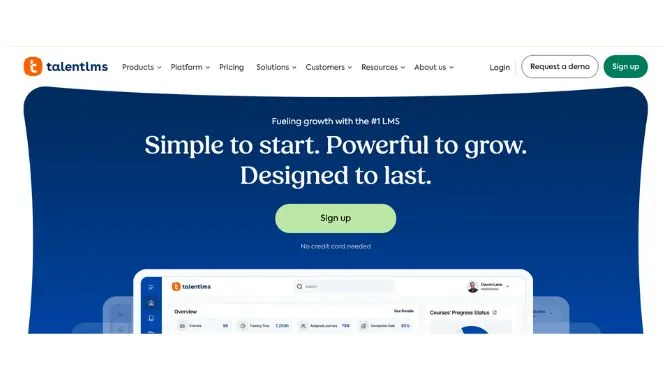
TalentLMS is a cloud-based learning management system designed for organizations that need a simple and fast way to deliver and track training. For restaurants, it works well as a centralized place to assign courses by role, monitor completion, and replace informal shadow training with structured, trackable learning.
Its interface is intentionally straightforward, which makes it easier for restaurant teams to adopt without extensive setup or technical configuration. TalentLMS is commonly used for new-hire onboarding, policy training, and basic compliance refreshers, where speed, clarity, and completion tracking matter more than complex customization.
For restaurants looking to move away from paper checklists and ad-hoc training methods and implement a digital training system quickly, TalentLMS offers a practical, low-friction starting point.
Key features
- Offline learning: staff can download courses and sync later (useful for spotty Wi‑Fi)
- Branches/portals: separate training portals for locations/teams
- Role-based assignment: assign onboarding/refreshers by role
- Gamification: badges/leaderboards to boost completion
- SSO options: available on higher tiers
- Fast setup and simple admin
- Offline-friendly mobile learning (great for shift teams)
- Gamification can improve completion rates
Pricing
TalentLMS offers tiered subscription plans based on the number of users and features. There’s a free tier for small teams, followed by paid plans ranging from around $69–$249 per month (when billed annually) for growing restaurants. Larger deployments with advanced features and integrations fall into custom enterprise pricing provided by TalentLMS sales.
4) Absorb LMS

Best for
- Restaurants where staff adoption is a challenge
- Operators who want clear, reliable reporting without manual tracking
- Teams training multiple roles or audiences across locations
Absorb LMS is a cloud-based learning management system designed for organizations that need a polished learner experience combined with configurable reporting and analytics. For restaurants, it’s a solid option when the primary challenge is getting frontline staff to actually complete training while still giving managers and operations leaders visibility into progress and gaps.
Absorb places a strong emphasis on usability, making it easier for shift-based teams to navigate training without friction. It also supports structured learning paths and reporting views that can be tailored for different stakeholders, such as general managers, area managers, and HR teams. If your current training system feels difficult to use or has low completion rates, Absorb is often evaluated as a more accessible alternative.
Key features
- Mobile learning app: Enables staff to complete training on their phones; offline access may be available depending on configuration
- Role-based learning paths: Structured onboarding and ongoing training by job function or location
- Reporting and dashboards: Track completions, identify skill gaps, and schedule recurring reports
- Automation tools: Notifications and reminders to reduce manual follow-ups
- Multi-audience support: Train employees, managers, and external groups (such as franchise partners) within one system
Pricing
- Costs are based on:
- number of learners
- required features and modules
- implementation and support needs
5) SAP Litmos

Best for
- Compliance-heavy operators (certifications, safety programs)
- Groups that need dashboards and automated reminders
SAP Litmos is best for restaurants where compliance documentation and audit readiness are top priorities for food safety programs, workplace safety, and mandatory policy training that must be tracked consistently. It’s strongest when you want dashboards, reminders, and reporting that make it easy to prove training happened and identify who is overdue. If you’ve been burned by missing certifications or inconsistent compliance follow-through across locations, Litmos is built for that problem.
Key features
- Compliance tracking + reminders: stay on top of required training across locations
- Reporting for oversight: audit-ready completion and overdue views
- Assessments: quizzes/checks to validate knowledge
- Content options: supports structured course delivery plus add-on libraries (varies)
- Free trial: commonly offered so you can pilot with one location
6) LearnUpon

Best for
- Multi-location brands building standardised on-boarding and role pathways
- Teams training different audiences (staff/managers/franchisees)
LearnUpon is a strong pick when you want to run training like a system structured programs, clear pathways, and consistent reporting especially across multiple locations or audiences. It’s useful for building repeatable on-boarding sequences, role-based development tracks, and separate portals for different groups (for example: staff vs. managers vs. franchisees). If your training needs are organised and programmatic, not just a loose set of videos, LearnUpon fits that operational style.
Standout strengths
- Strong reporting and organisation
- Integrations ecosystem
- Good for creating structured learning paths
Key features
- Learning paths: create role-based progressions (FOH/BOH/Manager)
- Portals/audiences: support separate groups (staff vs managers vs franchisees)
- Reporting: track progress and outcomes at scale
- Integrations: connect CRM/HR tools depending on plan
7) iSpring Learn

Best for
- Operators with existing training materials
- Teams that want a straightforward rollout + offline mobile access
iSpring Learn is ideal when you already have training assets, SOP docs, checklists, PowerPoints and you want to turn them into mobile-friendly, trackable learning fast. It’s a practical choice for restaurants that don’t want to build a training library from scratch, but still need consistent onboarding and proof of completion. If your current training lives in scattered folders and binders, iSpring can centralize it and make it measurable without a big rebuild.
Standout strengths
- Strong “build from existing content” workflows
- Offline-capable mobile learning
Key features
- Mobile app + offline learning: staff can train without being tied to a back office PC
- Active-user pricing model: useful for restaurants with seasonal/variable staffing
- Fast authoring: convert SOPs and existing materials into modules quickly
- Reporting: track completion and progress by team/location
Pricing
- Often cited starting point: around $3.58 per active user/month billed annually (varies by volume/plan)
- Free trial: available
Which LMS for Restaurants Is Right for You?
The best LMS for restaurants is the one that actually solves your specific problem. If you’re developing managers and want AI-powered coaching, look at Manager Maven AI. Running a large franchise needing enterprise compliance? Docebo makes sense. Want something simple up and running fast? TalentLMS will get you there.
Most platforms offer free trials. Test a few with your team, see what fits your restaurant’s workflow, and focus on what actually gets used—not what looks good in a demo.
Frequently Asked Questions (FAQs)
1. How long does it take to fully implement an LMS in a restaurant?
For most restaurants, initial setup takes 1–4 weeks, depending on complexity. Single locations or small groups can often launch faster, especially if they’re uploading existing SOPs or using prebuilt content. Multi-location brands may take longer due to role mapping, compliance requirements, and integration but even then, phased roll-outs allow training to begin before full implementation is complete.
2. How much does an LMS for restaurants cost?
Pricing varies widely based on features and restaurant size. Entry-level options like Manager Maven AI start around $16-19/month per user, while TalentLMS offers plans from $69-249/month for small teams. Enterprise solutions like Docebo and SAP Litmos use custom pricing based on your user count and needs. Most platforms offer free trials, so you can test before committing.
3. Can an LMS reduce employee turnover in restaurants?
While an LMS doesn’t replace wages or culture, it reduces early frustration, improves role clarity, and helps managers coach instead of constantly correcting. Faster onboarding, clearer expectations, and consistent feedback are all proven factors in improving retention, especially in the first 90 days.
4. Do I need an LMS if I only have one restaurant location?
Yes, even single-location restaurants benefit from an LMS. If you’re dealing with inconsistent training, compliance tracking headaches, or managers spending too much time repeating the same instructions, an LMS solves these problems. Platforms like Manager Maven AI are designed to work well for smaller operations without requiring complex setup or enterprise budgets.